
A Political Dance As Museveni, Bobi Strike A Fresh Deal
Kampala|FileFactsUg
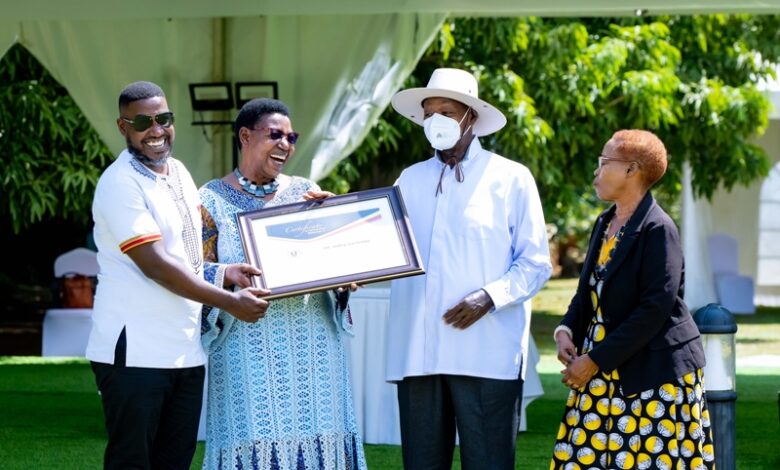
In an unexpected twist that has gripped the nation, President Yoweri Museveni and opposition National Unity Platform (NUP) leader Robert Kyagulanyi alias Bobi Wine have quietly struck a political deal.
The irony of this arrangement lies in its broker, the former Museveni minister, Miria Matembe, who has portrayed herself as a fierce rival to the president for decades now. Little did the public know that behind closed doors, this alliance was slowly taking shape, aiming to soften the opposition’s stance against Museveni’s longstanding rule.
During a public ceremony, President Museveni bestowed an award upon Matembe, honoring her as one of Uganda’s phenomenal women leaders.
Such recognition from Museveni for a figure many view as an adversary sent ripples of surprise through the streets of Kampala, raising eyebrows and suspicions about the motives behind this sudden public endorsement.
Could it be that Museveni values Matembe’s role in this unexpected partnership?
According to a leaked phone conversation between Joel Ssenyonyi, the spokesperson for the National Unity Platform (NUP) who is also Bobi’s confidant, and Matembe, the nature of the deal was revealed.
Matembe, conveying confidence and authority, informed Joel that Museveni had agreed to all demands put forth by Bobi Wine.
“…So, I could meet him somewhere. Because there is something I want to talk to him about regarding the issues he sent me for from State House, where the chief executive [President Museveni] agreed to all his demands in the proposal, and we wouldn’t want to delay given that the president is going to be very busy with his campaigns for the next term,” Matembe stated, indicating the urgency and significance of the agreement. In contrast, Joel appeared relieved and eager, a marked difference reflecting the dynamic at play between the opposition and the ruling government.
Not New
This fresh deal is no stranger to those who remember the momentous June 7, 2021 letter, when President Museveni ordered the release of Bobi Wine’s bulletproof car, previously seized by the Uganda Revenue Authority (URA) over an outstanding tax bill.
“This is to inform you that we have received a directive from His Excellency the President of Uganda to effect that Uganda Revenue Authority should release your client’s motor vehicle immediately,” read the letter from the Uganda Revenue Authority Commissioner General John Musinguzi Rujoki.
In the letter which was addressed to Bobi’s lawyers led by the late Anthony Wameli, it was indicated that tax bill amounting to Shs350m had been cleared by the President.
The same vehicle, initially presumed to be a powerful asset for opposition protests, ironically became a mere tool for attending social functions and parliamentary events rather than a weapon in Bobi’s campaign against Museveni.
Reflecting on the bulletproof vehicle’s unexpected fate, opposition supporters are puzzled. Despite possessing a supposedly invaluable asset, Bobi Wine has notably refrained from using it to mobilize the masses or stage anti-Museveni protests.
Instead, the vehicle has been transformed into a symbol of conformity, an echo of the very establishment Bobi claims to be fervently opposed to.
As the conversation between Matembe and Joel unfolded, the contrasting power dynamics between them became apparent.
Matembe, with her commanding presence, demanded swift action and expressed frustration with what she deemed the “unseriousness and laziness by my young sons yet me an old woman can swiftly push this your work through.”
Ssenyonyi, while cheerful, seemed cowed by Matembe’s authority, pleased nonetheless that their proposals had been met with approval by Museveni.
It was a representation of the shifting environment where opposition leaders appeared to dance to the rhythm of Museveni’s established order.
General Muhoozi
The broader implications of this deal throw light on Uganda’s political intricacies.
General Muhoozi Kainerugaba, the first son and Chief of Defence Forces, had previously hinted at a well-orchestrated plan, revealing that figures like Bobi Wine had been planted to overshadow Kiiza Besigye, a strong contender against Museveni.
“We are the ones that planted Bobi to overshadow Besigye,” he declared earlier this year via his X account, suggesting that even the opposition’s façade is crafted by the very forces they resist.
Indeed, Besigye languishes in Luzira prison, awaiting trials that never seem to come ever since he was abducted from Nairobi Kenya in November last year. His prolonged detention serves as a grim reminder of the turmoil that still defines Uganda’s political atmosphere, even as Bobi Wine and NUP appear to silently broker deals with Museveni.
The dance between Museveni and Bobi Wine, with Matembe at the helm, presents a complex tableau of power politics in Uganda, one that leaves many questioning who truly can be trusted?